How to keep score in padel

Padel scoring is tennis scoring with two changes. Points inside a game go 15, 30, 40, game. Six games with a two game lead wins a set. At 6-6 you play a tiebreak to seven. Most matches are best of three sets. The two changes are that many clubs replace advantage at 40-40 with a single golden point, and many replace a third set with a race to 10.
Keep score in a padel match, step by step
- Agree the format before the first serve. Best of three sets or one set, advantage or golden point at 40-40, and whether a third set is replaced by a super tiebreak to 10.
- Count the points in a game. 0, 15, 30, 40, then game. Win the game by two clear points if you play advantage, or by taking the golden point at 40-40.
- Count the games in a set. First pair to six games wins the set if they lead by two. At 5-5 you play on to 7-5. At 6-6 you play a tiebreak.
- Play the tiebreak at 6-6. First to seven points with a two point margin. Change ends every six points. The set goes down as 7-6.
- Call the score before every serve. Server's points first, then the receivers', then games if anyone has lost track. Saying it out loud is what stops arguments.
Points inside a game: 15, 30, 40
Each rally is worth one point. The first point is called 15, the second 30, the third 40, and the fourth wins the game. Zero is called love. A pair on 40 with the other pair on 30 needs one more rally.
40-40 is deuce. If you play traditional advantage scoring, a pair has to win two rallies in a row from there: the first gives them advantage, the second gives them the game, and losing the second takes the score back to 40-40. If you play golden point, 40-40 is settled by one rally.
The convention is to call the server's score first. At 30-40 with your pair serving, you are the pair on 30. Announcing it that way removes most of the confusion in social matches, because everybody knows which number belongs to whom.
Games inside a set: six, by two
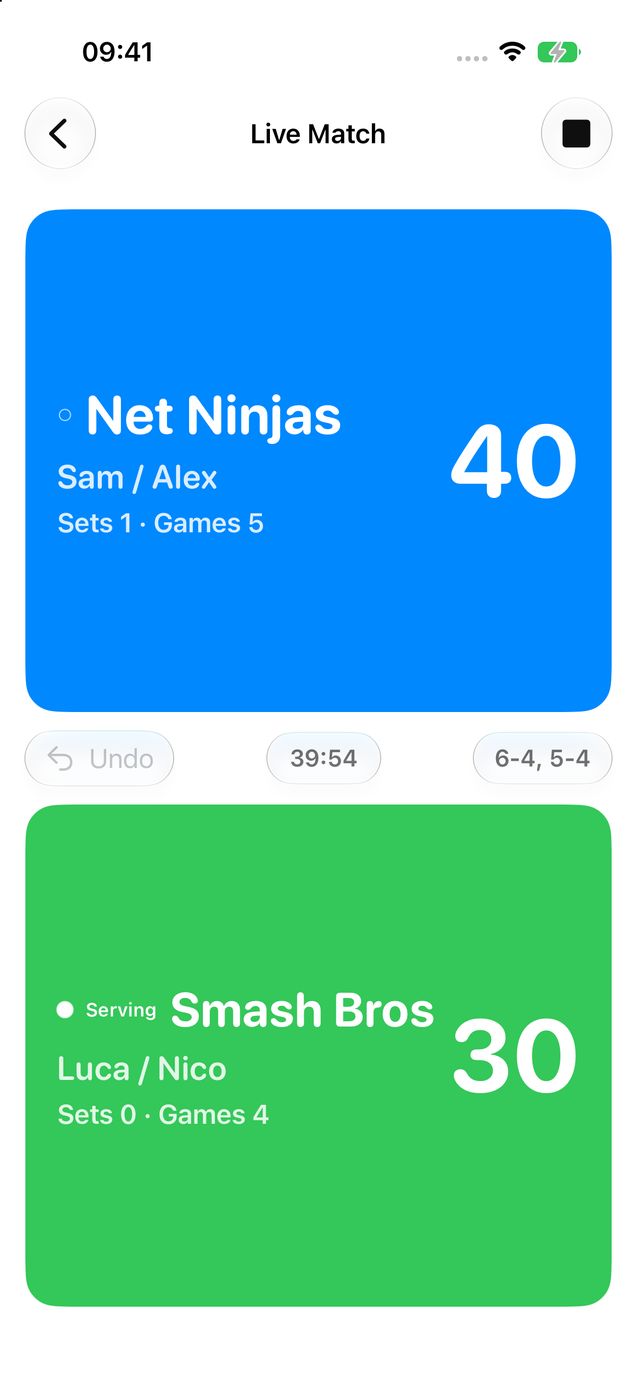
A set goes to the first pair that wins six games with a two game lead. 6-4 and 6-1 are finished sets. 6-5 is not, so you play on: 7-5 finishes the set, and 6-6 sends it to a tiebreak.
Service alternates game by game between the pairs, so if you served the first game, the other pair serves the second. Inside a pair, one player serves the whole game.
Ends change after every odd game: after the first, third, fifth and so on. Nobody in a social match tracks this perfectly, which is another reason to write the games down or let something else count them.
Sets in a match: usually best of three
Club and tournament padel is normally best of three sets, so the first pair to two sets wins. A full three set match runs well past an hour, which is why the super tiebreak exists.
Where court time is booked in fixed blocks, a single set is common, and so is a third set replaced by a tiebreak to 10. Decide which one you are playing before the first serve, not at one set each.
Which scoring mistakes start most arguments?
Three things go wrong in practice. Somebody forgets whether it is 30-40 or 40-30. Somebody serves out of turn after a tiebreak. And the games score drifts by one because a game was played twice in memory.
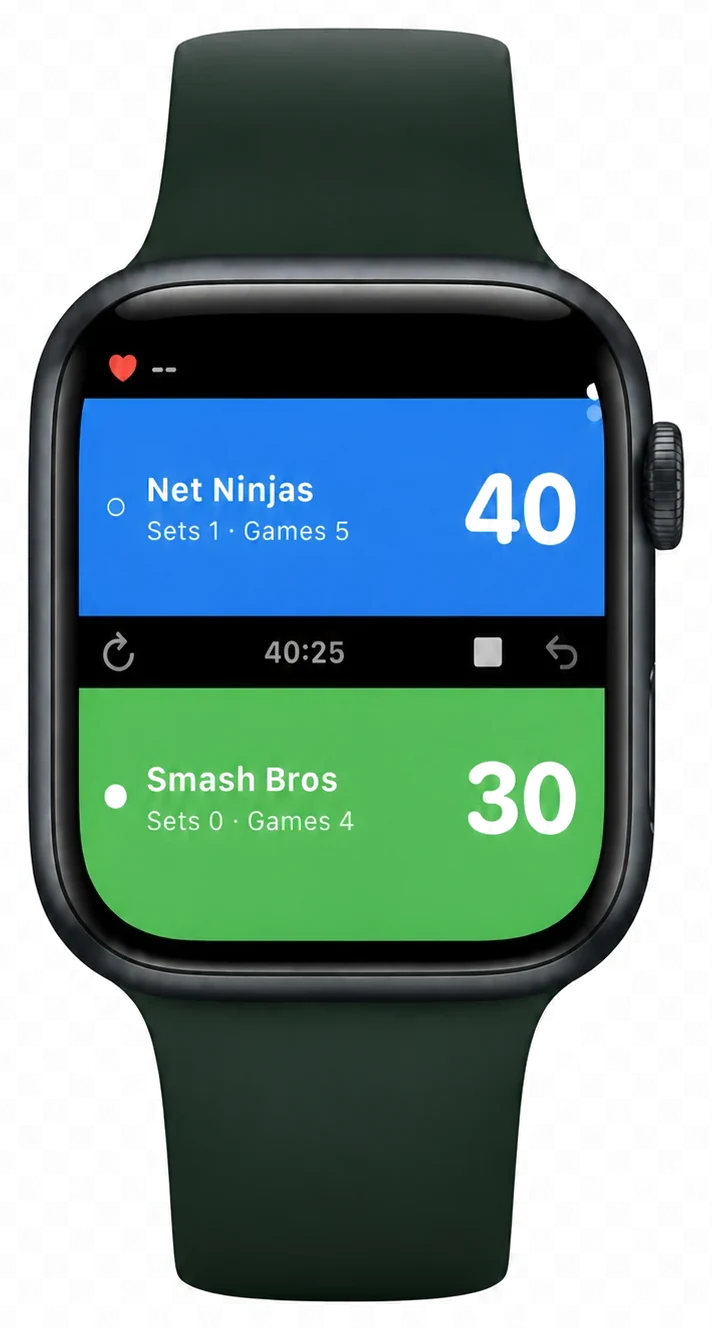
The fix that costs nothing is to call the score before every serve, loudly, server first. The fix that costs nothing to remember is a scoreboard, whether that is the club board, a phone on the bench, or the watch on your wrist.
Questions people also ask
Why is it called 15, 30, 40 instead of 1, 2, 3?
Padel inherited the numbers from tennis, which took them from a clock face used for scoring in the medieval game of jeu de paume. The 45 became 40 in speech, and it stuck.
Do you have to win a padel set by two games?
Yes, up to 6-6. 7-5 is a valid set score, 6-5 is not, and at 6-6 the tiebreak decides it, which is recorded as 7-6.