
Padel tiebreak rules

A padel set tied at 6-6 is decided by a tiebreak. The first pair to seven points wins it, and they have to be two points clear, so 7-6 does not end it and the tiebreak continues to 8-6, 9-7 and beyond. The set is recorded as 7-6. Points are counted 1, 2, 3, not 15, 30, 40.
Play a padel tiebreak at 6-6, step by step
- Start with one serve. The player whose turn it is to serve serves the first point only, from the right hand side.
- Alternate every two points. After the first point, service passes to the other pair, and from there each server serves two consecutive points.
- Change ends every six points. Change ends at 6 total points played, then at 12, and so on. Play continues without a break.
- Win by two. First to seven points takes the tiebreak if they lead by two. At 6-6 inside the tiebreak, play on until a pair is two points clear.
The score inside a tiebreak
Tiebreak points are plain numbers. 1-0, 2-1, 4-3. There is no 15 or 40, and there is no advantage. Call the total of the pair serving first, the same convention as the rest of the match.
Seven points wins it, with a two point margin. That margin is the part people forget: at 6-6 in a tiebreak you keep playing, and a tiebreak that reaches 10-8 is perfectly normal.
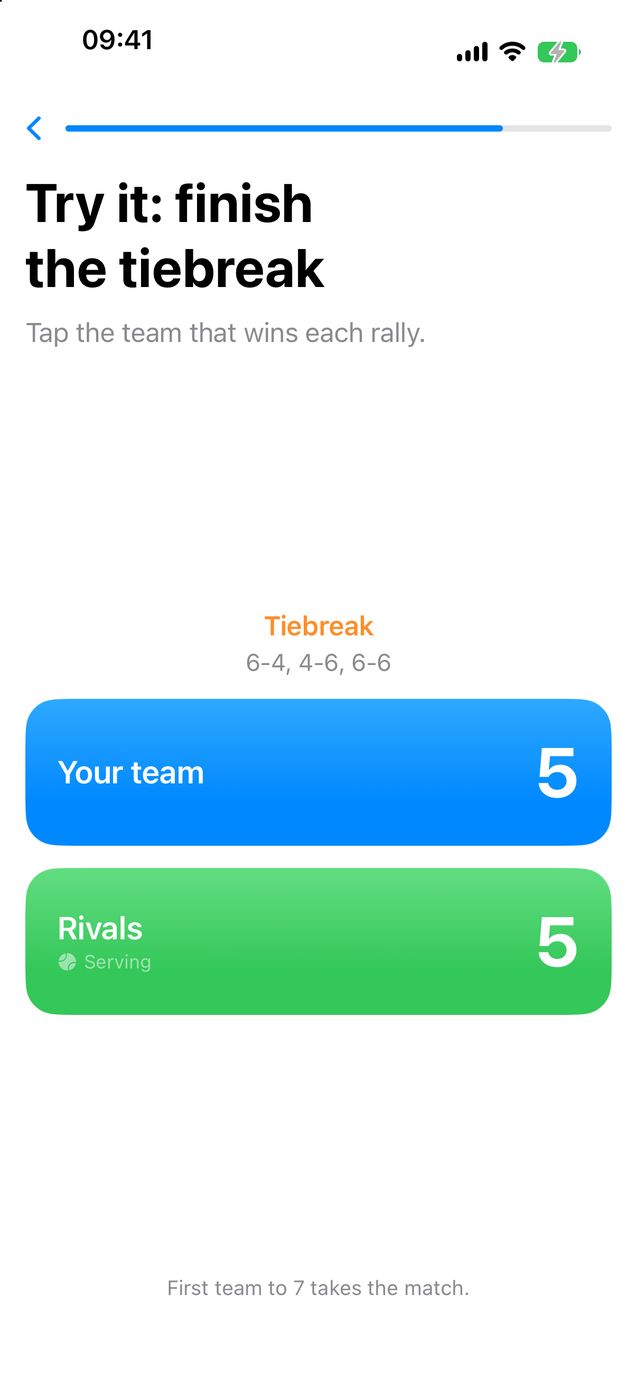
Who serves when in a padel tiebreak?
The first point is served by one player only. Then service moves to the other pair for two points, back for two, and so on. The effect is that the pair who served the first point also serves the eighth, and the whole thing stays balanced.
This is where wrist and paper scoring usually breaks. After four or five rotations, one pair is convinced it is their serve. Adding the two scores settles it: service changes whenever that total is odd. After point 1, then after 3, 5, 7, and so on, never after an even total.
If someone does serve out of turn, the points already played stand. The correct server takes over as soon as anyone notices, and the two point pattern carries on from there.
Ends, sides and what carries into the next set
Change ends every six points played inside the tiebreak. When the tiebreak ends, the set is 7-6 and the next set begins with the serve going to the pair that did not serve the first point of the tiebreak.
That last detail is the second common argument, and it matters because getting it wrong hands a service game to the wrong pair for the rest of the set.

Questions people also ask
Can a padel tiebreak go past seven points?
Yes. Seven only wins it with a two point lead, so a tiebreak can run to 8-6, 9-7, 12-10 or further. The set score is still written 7-6.
Is a tiebreak played at 6-6 in every set?
In standard best of three padel, yes, including the third set. Where a super tiebreak replaces the third set, the third set never reaches 6-6 because it is not played.